Police Chief Makes Bold Promise to Youth

Legal car sideshows, local hiring

By Gini Brown

Taking a look back at my freshman year I would have never thought that I would be sitting down with Oakland Chief of Police Anne Kirkpatrick and her fellow officers, as well as City Council member Desley Brooks, to talk about resolutions for issues in our community.

A lot of people will wonder what will make an East Oakland teen want to sit down with the police. Well, for a while I always wondered where that side was coming from and what was going through their heads on the daily.

Sitting down with them provided a chance for the chief, council member, and community members to come to some agreements.

First of all, you know them sideshows everyone loves, but can never go to because it’s too dangerous, or the police are always shutting it down? Well, during this talk, the chief agreed to start the process of putting together a sideshow in a designated area and making it a safer environment — but keeping it the same fun event for people.

“Legal sideshows will be difficult because it requires a lot of moving pieces aside from putting it together,” said community activist Mya Whitaker, Skyline class of ‘09, who set up the meeting. “That does not mean it can not or will not be done.”

Another agreement we were able to come up with was being able to prioritize local young people for a certain number of jobs in the Oakland Cadets police force training program. As of August 2015, only 8 percent of all Oakland police officers actually live in our city, which some say hurts their ability to do their job well.  

There is a graduating cadet class from Merritt College this semester, so we will be watching to see how many are from Oakland, as well as keep pushing to make legal sideshows a reality.

Lines are a Mess

Students should be able to get their food quickly, safely

By Simon Huang

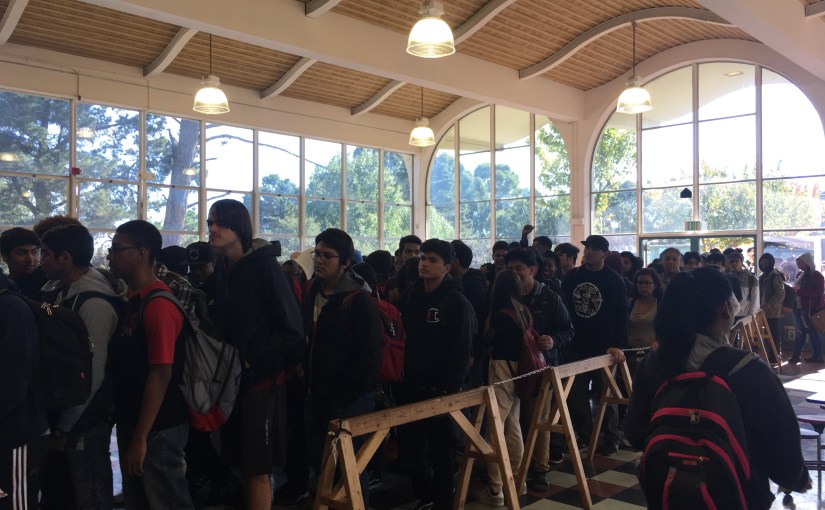
Let me tell you how much I hate waiting in the lunch line. One issue I have with the lunch line is that it’s crowded. It makes me uncomfortable from the number of people I am being surrounded by when I wait in line every day. If I was a claustrophobic I wouldn’t even go near the lunch line and make my own lunch at home, but I would’ve done that a long time ago if only I had the time to make myself lunch.

I don’t even have the money to buy my own lunch and the school’s lunch is my only option to get something to eat for free. One time when I was waiting in the lunch line, someone behind me pickpocketed me and I didn’t notice. My clipper card was stolen and I always kept it inside my backpack in the small pocket in front of my backpack which was easy to open while standing behind me. I can’t believe how easy it was to have things stolen from me while standing in the lunch line.

What pisses me off the most is when I have to wait in line for lunch and some students would cut in line rather than wait in line. This happens way too often and it’s impossible for the security guards to catch all of those who cut. Sometimes other students would just push through the line to get ahead or just to be near a friend.

I feel like the solution to the lunch line is to have people who want lunch sit at the lunch tables. Then a security guard calls out a table or more, and the people sitting at the tables that were called on will get up and get their lunch. Once the students get their lunch, another set of tables will be called on and those students who got their lunch will get to sit down and finish their lunch or finish their lunch outside the cafeteria.

Students that aren’t seated are able to sit down after a student gets up to get their lunch. After a student finishes their lunch while sitting at the lunch table they should get up to give other students a seat to sit and wait to be called on. Rinse. Repeat. Once the majority of people have gotten their lunch it’s safe to go get your lunch without having to sit on the table. I know this isn’t a perfect solution, but I definitely think that the lunch line needs to have a way to be more organized and faster.

Officer Campbell, a campus security guard working at Skyline High School for two years, gives his input on what he thinks about the school’s lunch line. “I like how the line is efficient enough with how the line is set up with the chains to keep students in line, but it’s very crowded with only one line for the whole school. It would be better to have two lines instead of one, but the school is going to have to remodel the cafeteria because it isn’t fit for more than one line,” he said.

The lunch line would benefit with having a second lunch line. It would make the line less congested which makes the traffic in the line smoother and serving students faster. I hope that the school will think of a way to improve the lunch line since it’s been a problem for a while. The second lunch line could be placed parallel to the other lunch line, but the lunch tables would have to be rearranged in order to make room for the second lunch line.


Violence Flares at Tech Game

Fights break out during event, but tension started earlier

By Noah Mitchell

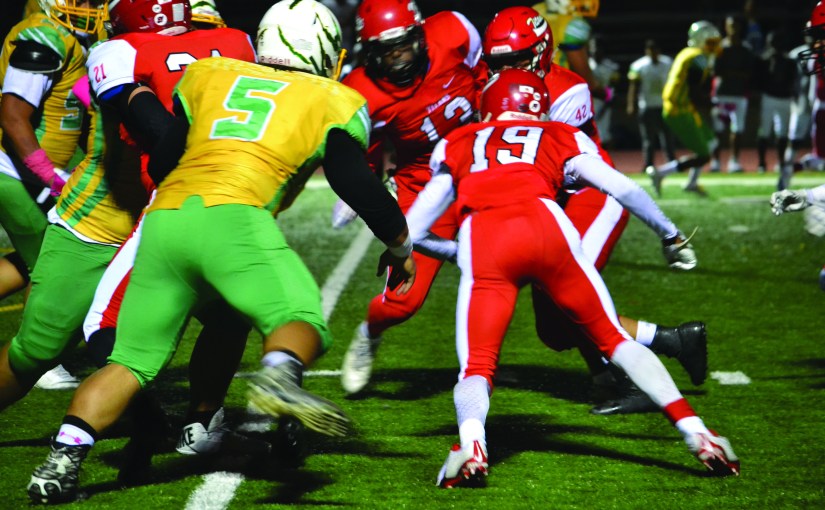
When the Titans play the Bulldogs and vice versa, it’s a pretty big deal on both campuses. Especially during football games. Hype and tension usually build up leading into the biggest game of the season, but this time it was overwhelming and ended up with total chaos.

“The conflict that developed during the game had its roots earlier in the week, as players from the two teams started directing taunts at each other via social media,” explained the principals of Skyline and Oakland Tech in a joint statement addressed online to the communities of both schools.

“The low point prior to the game was when four players from Tech went to Skyline during lunch looking to fight some of their rivals. Those four players were banned from playing — and even attending — the game Friday night.”

As senior Josh Ahanonu, a team captain [and a Titan Times Sports Editor], recounted, “Some players from Tech game came to Skyline talking mess until [Assistant Principal] Carson came and wrote their names down and reported them.”

By the 2nd second quarter, the score was 7-6 in favor of Skyline. The crowd was pumped up for their team as usual. However, a student, who wishes to remain anonymous, recounted a few moments that kicked off the mayhem.

“There was a dispute between a Tech parent and coach which caused a long pause where all the players from both teams knelt on the field,” the student said. “This left room for two students to brawl behind the bleachers.”

Later in the letter, Ms. Bloom stated that,  “At the game, the rivalry became far more than just a  friendly competition, as fans took matters into their own hands and the two teams could not keep their emotions under control.”

Finally, with talk of a shooting  nearby possibly being linked to the  tension surrounding the football game, the principals said this was not the case.

“Lastly, we wanted to inform all of you that there was a shooting near the neighborhood after the game that was not connected to the issues at the game and is being investigated by the Oakland Police Department.”

Fights break out during event, but tension started earlier


By Noah Mitchell

Free Meals for All

More eating, but longer lines

By Janae German

Who doesn’t love free food? Well, Skyline is offering.

This year Skyline is giving out free breakfast and lunch daily to ALL students, and not just those from low-income backgrounds. The access to free food offers the entire campus a better chance to eat every day.

Free access to food helps a lot in easing the stress of coming to school and not having money to pay for it. It also grants students the opportunity to buy other, more desired products from the school snack vendor, like chips, soda, and candy. “It’s good, everything is free,” Hollis Acklin, a freshman, said.

It would appear, from the longer lunch lines this year, that the policy change is working to get more kids to eat at school.

Free lunch impacts students academically too. “Lunch is lunch and everybody needs food, so I think it’s great. Financially, everybody doesn’t have the money to pay lunch. I think free lunch is primary to school because it keeps students energized and students ready to learn,” said Sam Hill, a nighttime lead janitor. Students who eat lunch or breakfast don’t feel as tired during the day and helps them be more attentive in class.

Oakland has offered free lunch to students for a relatively short time, first being offered exclusively to low-income students starting in 1946, and just this year at Skyline to all its students. It wasn’t until 1975 that free breakfast was given the same treatment.

So who do we have to thank for this amazing advantage? Assistant Principal Garret-Walker was enthusiastic to give the answer: “We have a really rich history of Oakland when it comes to low income, and students getting free lunch; and we can thank the Black Panthers for that.”

The Black Panthers, an influential Black activist organization, famously founded a school in Oakland in 1969 and gave away free breakfast to nieghborhood kids.

Having the advantage of free food gives students the opportunity to not worry about if they will be able to pay for their lunch.

So with all the free opportunities to eat on campus, is there really any reason not to get free food?

Teacher Faced Fire

Mr. Johnson lives in destruction zone

By Rejanea Rhone

When massive, deadly fires raced across North Bay counties ahead of hot winds this October, Skyline students mostly paid attention only through the news, or because of the smoke pollution that drifted down to Oakland over the next weeks.

“The smoke made my chest hurt and I had to wear a mask,” said Nevaeh Iglehart, a junior.

However, for Skyline history teacher Mr. Johnson, who commutes to daily from one of the counties most affected, it hit a lot closer to home, literally.

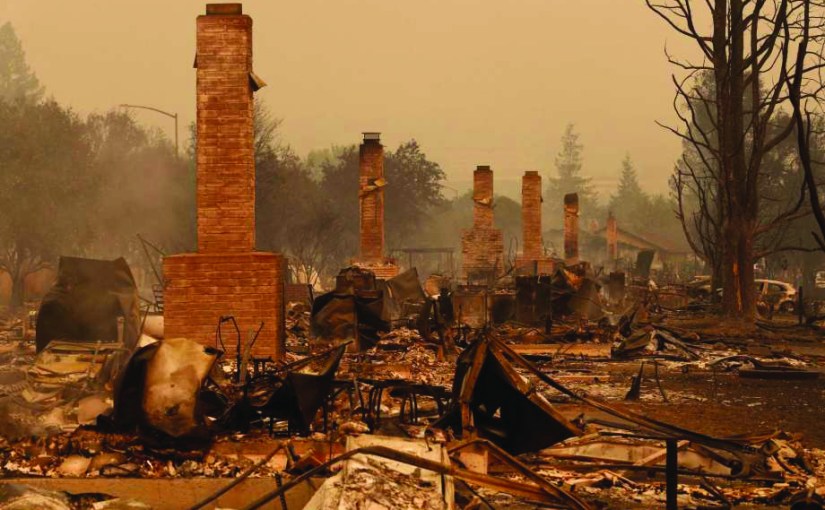
“Twenty of my friends lost homes,” said Johnson, who lives in Sonoma County north of the most destructive of the dozen fires that were burning then. Called the Tubbs fire, it killed 22 people, destroyed 5600 structures, and became the most expensive wildfire in California history, in terms of property damage. “It was stressful, everything was gone.”

While his own residence was safe, Johnson missed several days of teaching as he volunteered in the distressed zone, helping friends and even making soup in shelters for those displaced by the flames. He said pictures could not capture the destruction he witnessed.

For Skyline students, though, the main impact was several days of extremely polluted air as smoke drifting from the fires created unhealthy conditions around the Bay. Some students overreacted, believing they were going to die, and parents were concerned enough to repeatedly call Oakland Unified to ask whether or not school would be cancelled.

“The smoke made it uncomfortable to be here,” said junior Elise Luna.

Students who have certain health problems, such as asthma, were particularly affected. Some after-school events and practices were cancelled, and attendance on some days was way down, but the school stayed open each day.


Deportations Possible for Undocumented Youth in Oakland

By Allison Dang

Many students were upset when Donald Trump was elected president, especially because of his extreme anti-immigrant and even racist statements.

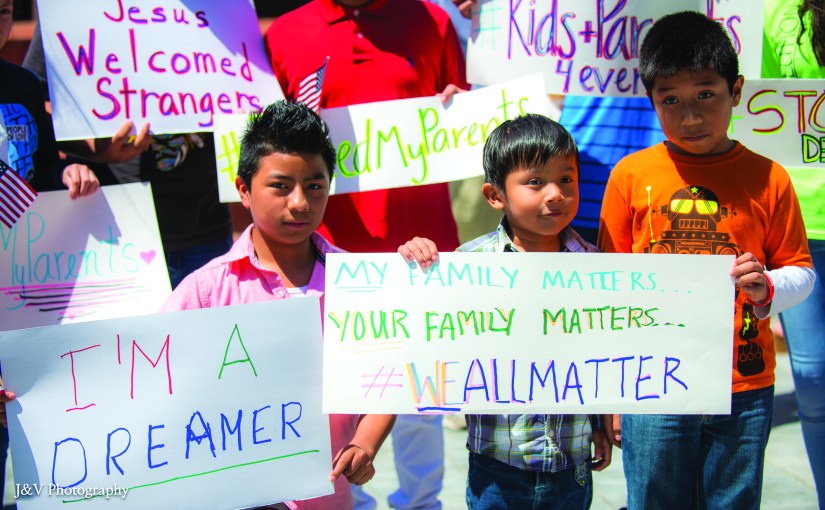
On September 5, one of their big fears was realized when the new president announced the end of an executive order created by former President Obama, called Deferred Action for Child Arrivals (DACA), that allowed minors who had entered the country illegally to stay, as long as they renew the permission every two years.

After their current permission runs out, they can be detained, deported, and torn from the life they’ve known for much of their life. Roughly 800,000 childrens will be affected by the decision to end DACA, and its cancellation has brought much fear to both students and their families here in Oakland.

For junior Alex Trujillo, it hits her close to home, as it directly affects her sister whose birth home was Michoacan, Mexico.

“I’m sad that just because they are from a different country they are treated differently and imp

roper,” she said. “[They] don’t get the same opportunity as someone from the U.S.”

Her sister was in the DACA permission process just as its cancellation was announced. She said her family is looking for a lawyer to help. No DACA permission applications were accepted after October 5, 2017.

“I think DACA needs to stay active because all the people who had it are working just as hard or even harder than the people who are originally from the U.S.,” said Alex, “and they should be treated equally.”
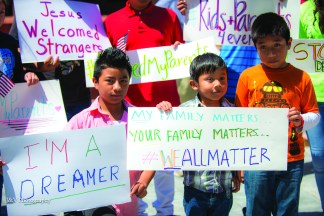
Mr. Barbuto, the head of the Education Academy, said he knows students who are deeply affected by Trump’s decision.

“I had students crying,” he said. They have a lot of “fear about what’s gonna happen to them and are just overwhelmed about what they can do for their future and what they can do about [the end of DACA]. Because they were giving the opportunity to move towards becoming legal in the U.S., but now [there is] a pushback, a setback.”

Since Trump overturned Obama’s DACA policy, defenders of undocumented immigrants have turned to Congress, hoping it will make a law that provides similar temporary protections for young undocumented immigrants. However, with the president’s Republican Party controlling both houses of Congress, such a solution seems unlikely before 2019.

Without DACA, even those who manage to avoid deportation still face unique obstacles to advancement. In some states, for example, they are specifically not allowed to attend public universities. “Alabama and South Carolina forbid undocumented immigrants from enrolling in all state universities, while Georgia forbids them from enrolling in some state universities, according to the National Immigration Law Center,” Alan Gomez told USA Today.

Even if they are allowed to attend public colleges, as they are in liberal California, it will be more difficult to to find funds than for those students who are citizens or have legal permission to live here. The end of DACA means they will lose their work permit, for example, making it harder to provide for themselves. Federal student loans and grants will also be inaccessible.

There are many resources like the Immigrant Resource Center to help their situation, but because of all the current commotion, most of the places offering free or affordable services are busy and packed with many cases. “It’s a lot easier to get service if you pay for it but not a lot of students can do that,” said Barbuto.

For Alex Trujillo, the person to blame for this suffering is clear. “I think [President Trump] is a heartless person because he treats undocumented people as if they aren’t humans but we all are the same,” she said. “Sadly, he doesn’t see that.


Tennis Team Is Robbed

By Paul Phelan and Noah Mitchell


While people may disagree on whether Titanpalooza was fun or not, most people can agree that business was good, helping clubs, sports teams, and other groups make hundreds of dollars to support programs.

“We made a total of $500,” said Antwan Adams, working at one of the stands with long lines.

However, there was one major exception to the good news, the tennis team. Sales of boba tea were booming — until somebody stole all their revenue.

According to an athlete who wished to remain anonymous, the thief was standing in front of the stand, and the members of the club thought he was going to buy something. Instead, he grabbed their money envelope and ran off.

“I don’t know exactly, but [they took] around $300,” she said. Unfortunately, nobody was able to recover the money, as it was passed around by multiple students. The student who initially stole the money was a freshman, according to the tennis club members.

Leadership was in charge of the event, and heard what happened. Fortunately for the team, Leadership generously was able to repay around $150, about half of what was lost.

Despite the compensation for the losses, this theft and others raises the question what can and will be done to prevent future occurrences like these?


Popular Coach Remembered

‘The realest person at Skyline,’ Carlo Tateo was a mentor to many

By Gisell Hernandez-Noyola

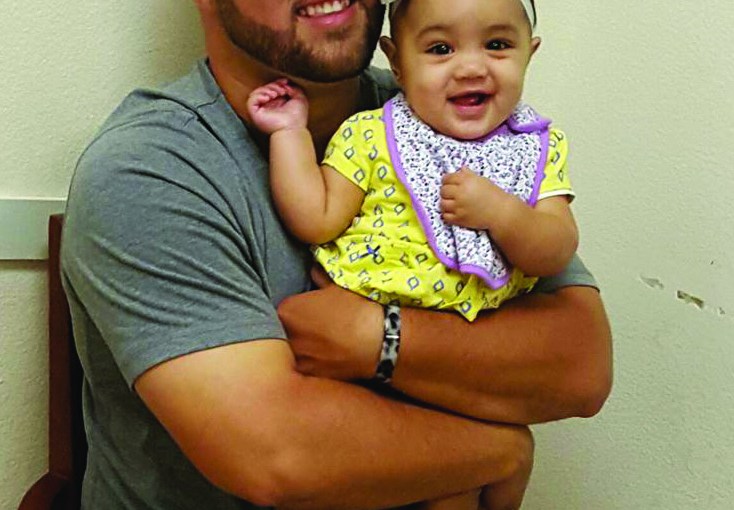
This  past summer, Skyline lost a beloved staff member and alumnus, PE teacher and coach Carlo Tateo. Early on the morning of June 18, Father’s Day, Tateo  was gunned down by an apparent stranger outside a San Francisco nightclub.

“He was a very caring person who is truly missed,” said Coach Salazar.

Tateo, a 31-year-old father who worked at Skyline for three years and himself graduated from the school a decade before, was treated for his injury on the scene, but later passed away at Zuckerberg San Francisco General Hospital. He leaves behind a partner and two-year-old daughter.

Students and staff saw Tateo as a caring friend who would put others first. Tateo was well known for being kind hearted and filled with lots of life and energy. He strived to help troubled teens find a correct path in life.  

CYMK Tateo grad

“When I would skip [class] he would give me advice and was always there when I needed someone to talk to,” said Estrella Amezcua. “He would make me laugh.”

Even Skyline students who didn’t know him through his football coaching appreciated and had a great amount of respect towards him because of the type of person he was.

“Tateo’s laugh and smile [would] lighten up the room,” said Claire Chao. “[He was] the realest person at Skyline.”

Hundreds of students, teachers and other staff gathered in the gym two days after the shooting to mourn, even though school had closed for the summer break. Standing in an oval around the basketball court, individuals took turns sharing their favorite memories of their late mentor, friend, teacher, coach and colleague.

Calling him a campus “prophet,” Coach Bates called Tateo’s character “second-to-none,” according the East Bay Times. “He was able to connect instantly with toddlers, infants, teenagers, peers, people of like age, different age and the elderly. It was natural for him. He could blend with any group.”

According to the SFPD, the investigation is still open and they are still searching for those responsible. On September 20, the department released surveillance video of three “persons of interest” in the case who had been loitering in the area where the shooting took place.

“We do not believe that the suspects or Mr. Tateo had ever met before,” McEachern told reporters. “Those individuals (the three wanted for questioning) had been in the area for about an hour (before the shooting) – talking with patrons coming and going from the area so it wasn’t as if they had just shown up and got out of a car.” Police would not reveal which of the three they suspected, but said they had identified the gunman.

Unfortunately, as of mid-December, there had been no announcement of developments.

“His life was about helping young kids, kids in trouble,” Tateo’s uncle Don Apperson told CBS News. “He worked at a recreational center in East Oakland where he helped troubled teens in the area to get their lives together.”

Tateo’s family is hoping the community will help police find the killer or killers.

“If you recognize someone, please make a phone call. We don’t want this to happen to another family,” Sonja Tateo said.

Return of La Raza

Club celebrating Latino culture is back on campus

By Kimberly Abarca

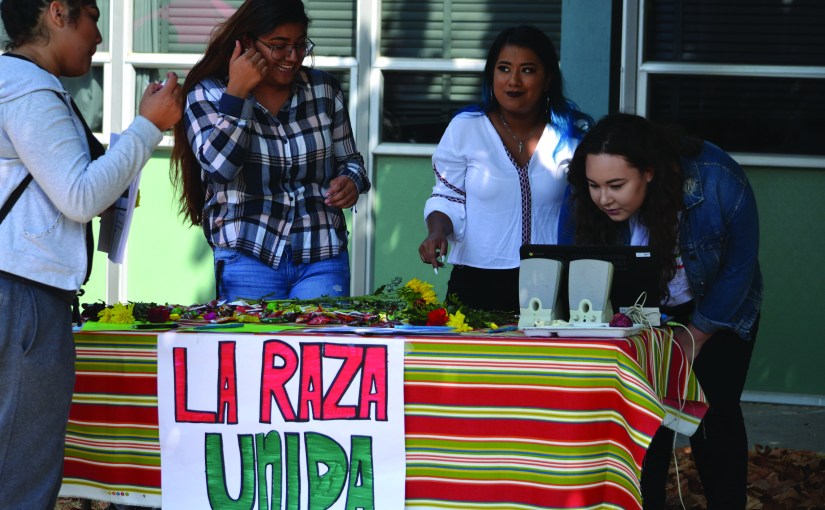
La Raza is a club at Skyline that was brought back last year and continues to grow. First established by Ms. Elias back in 1998, the new version of the group  is led by senior Nathalie Reyes and meets during lunch every Tuesday.

As of this reporting,  15 students had already joined the club.

Students in La Raza talk about their culture and social problems. The purpose of the club is to represent the latino culture and get more people involved in its  traditions.

La Raza, which can be translated as “The People,” takes its name from the activist Chicano (Mexican-American) movement of the same name, which joined other civil rights organizations in the 1960s and 1970s to demand a more just, equal society.

Reyes, the club president, explained La Raza members come up with ideas for ways to participate on campus, whether it be for Hispanic Heritage Month, Titanpalooza, or the club’s annual cultural assembly.